
AMIROUCHE Mawhoub
The course instructor is responsible for presenting the theoretical concepts related to irrigation, drainage, agricultural water management, and the sizing of hydraulic systems used in agriculture.

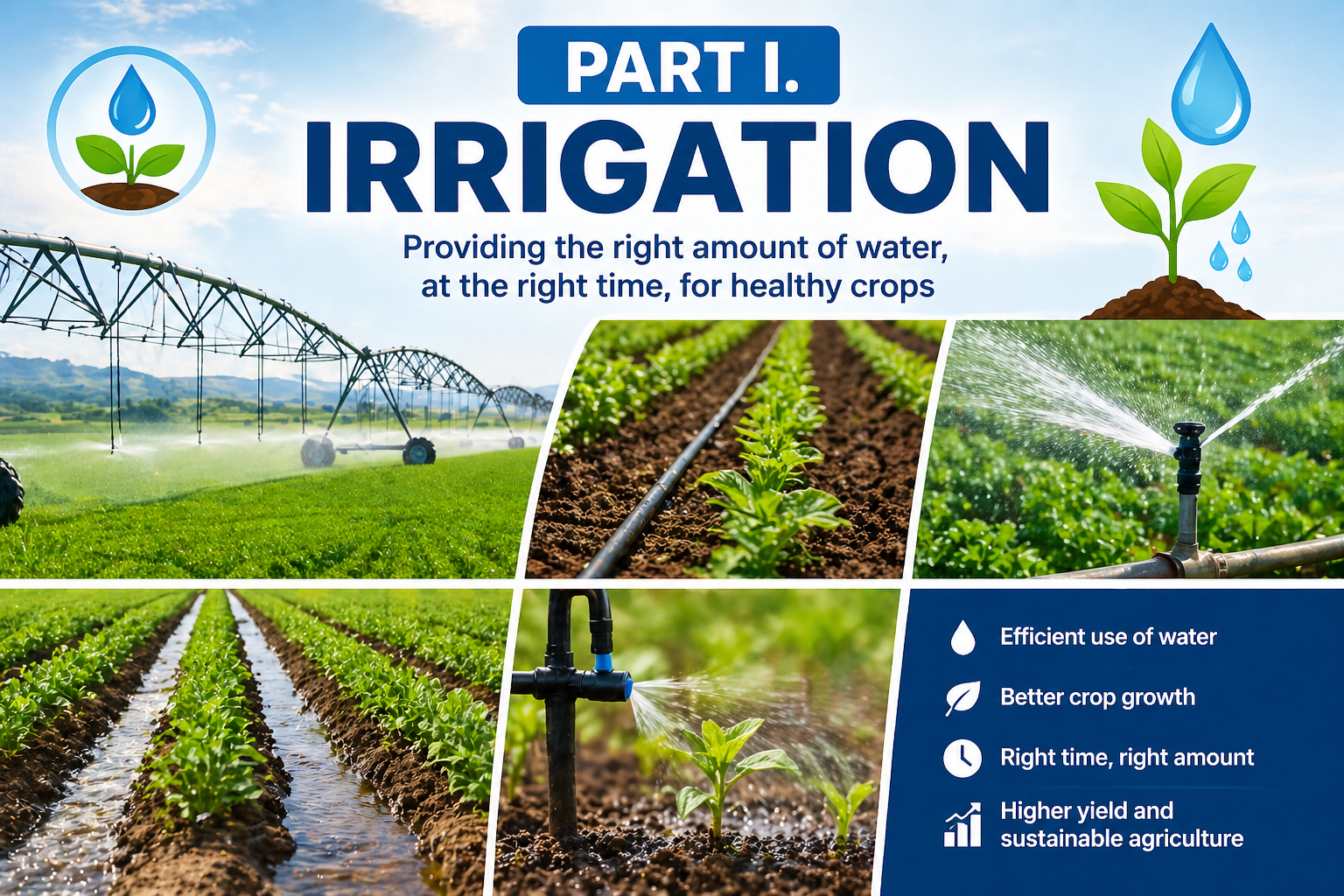
The Irrigation and Drainage course enables students to acquire the fundamental knowledge required for the design, management, and evaluation of agricultural irrigation and drainage systems. It introduces the main principles of crop water supply, plant water requirements, soil characteristics, and methods for ensuring the rational and sustainable use of water resources.
This course also covers different irrigation techniques, such as surface irrigation, sprinkler irrigation, and localized irrigation. Students will learn how to analyze the parameters that influence the choice of an irrigation system, including soil type, crop type, water availability, climate conditions, and economic constraints.
Special attention is given to agricultural drainage, which is essential to prevent excess water in the soil, salinization, and degradation of cultivated lands. By the end of this course, students will be able to understand the overall operation of an irrigation and drainage network, size some basic components, and propose suitable solutions according to field conditions.
To take this course, students should have basic knowledge of hydraulics, agronomy, soil science, and climatology. A good understanding of simple calculations, measurement units, flow rates, water volumes, and the physical characteristics of soil is also recommended.
The course instructor is responsible for presenting the theoretical concepts related to irrigation, drainage, agricultural water management, and the sizing of hydraulic systems used in agriculture.
The Open edX platform works best with current versions of Chrome, Edge, Firefox, or Safari.
See our list of supported browsers for the most up-to-date information.
This course is intended for students in agronomy, agricultural hydraulics, rural engineering, or any field related to water and agricultural land management.
The main objectives are to understand crop water requirements, choose an appropriate irrigation method, analyze excess water problems, and propose effective drainage solutions.